Most homeowners have a roof replaced once, maybe twice. The crew has done it hundreds of times, which
means a great deal goes unexplained simply because it is routine to them. Here is what the day actually
looks like on a typical single-family re-roof in Hillsborough County, and where the county’s inspection
process fits into it.
Before anyone arrives: the permit
A re-roof needs a permit, and the permit has to be in hand before work starts. Your contractor pulls
it; you should be able to see it. Along with the permit application, Florida requires a signed
attestation confirming that the roofing portions of section B110 of the Florida Building Code,
Existing Building, will be followed. Hillsborough County requires that document as part of the re-roof
submittal.
This is not paperwork for its own sake. The permit is what triggers the county inspections described
below, and those inspections are the independent check that the roof was built as specified. A re-roof
done without a permit leaves no record that anything was inspected, which becomes a problem at sale and
can become a problem with an insurer.
You will usually be asked to clear a few things in advance: move vehicles off the driveway, take down
anything fragile hanging on interior walls, and clear patio furniture and potted plants from around the
perimeter. It is also worth agreeing where the dumpster or dump trailer will sit.
Setup and protecting the property
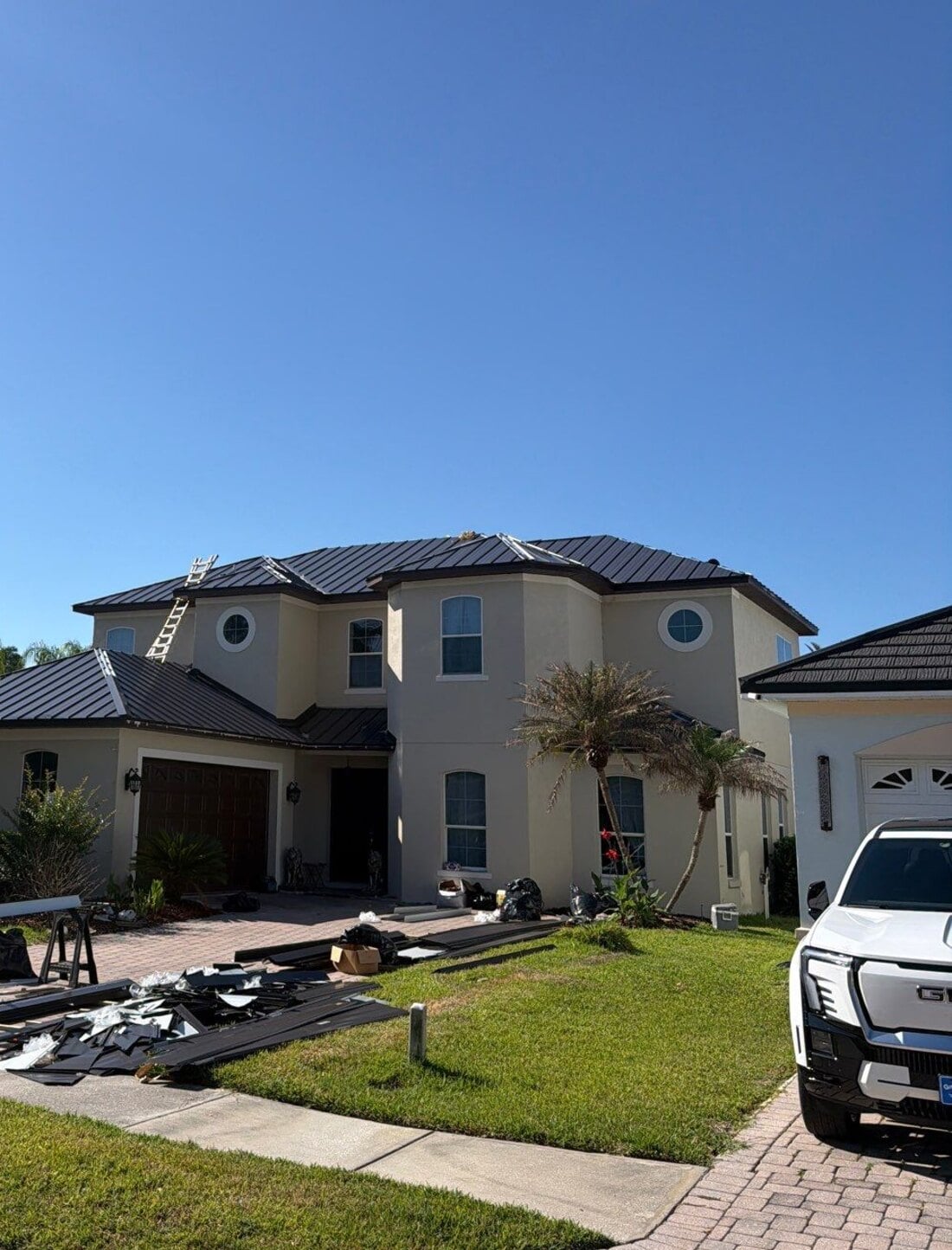
The crew’s first hour is not spent on the roof. It goes on setting up: positioning the dump trailer,
laying plywood or boards to protect the driveway, running tarps down the walls and over landscaping,
and setting up ground staging for materials.
This part is worth paying attention to, because it is a reasonable proxy for how the rest of the job
will be run. A crew that protects your air conditioning condenser, covers the pool and tarps the shrubs
before anything comes off the roof is a crew that is thinking ahead.
Expect noise from here on, and expect it inside as well as outside. Tear-off transmits through the
structure, and if you work from home it is honestly better to work elsewhere for the day. Pets should
be kept indoors and away from exterior doors.
Tear-off, and what the deck reveals
The old covering comes off down to the deck. This is the loudest and fastest-moving part of the day,
and it is also the part where the scope can change, because until the roof is open nobody can see the
sheathing.
What can turn up: soft or rotted sheathing that has to be replaced, fasteners that do not meet
current requirements, or previous repairs that were never done properly. None of this is unusual on an
older Florida home, and a good contractor will show it to you and photograph it rather than simply
adding a line to the invoice.
One county-level rule is worth understanding in advance, because it is the most common cause of a
scope change. Where a roof is being repaired or replaced and the existing structure was permitted under
an older edition of the code, Florida’s roof-mitigation requirements can be triggered once more than a
quarter of the roof area is involved. In practice that can mean bringing the roof-to-wall connections
and the deck attachment up to current standards. Hillsborough County’s re-roof guidance refers to this
as the twenty-five per cent rule, and whether it applies turns on when the existing roof structure was
permitted relative to the 2007 Florida Building Code. Ask your contractor to tell you before the job
starts whether your home is likely to fall inside it.
Dry-in, inspection and installation
Once the deck is sound, the underlayment goes down. This is the dry-in, and it is the stage that
makes the house weathertight again. On a typical shingle re-roof, most crews aim to have the roof dried
in by the end of the first day for exactly that reason.
Here is where the first inspection happens. Hillsborough County requires a Progress Check inspection
on a re-roof, carried out after the dry-in and before the new covering goes on, so that the sheathing,
its attachment and the underlayment can actually be seen. The county also allows this inspection to be
conducted virtually, with photographs and video submitted as evidence, which in practice means the job
is not necessarily waiting on a site visit.
After the inspection passes, the new covering is installed: starter course, field material, then the
flashings, boots and hip and ridge caps. On most single-family homes the whole sequence runs one to
three days depending on size, complexity and weather. Afternoon storms in summer stop work, and a good
crew will stop early rather than open up more roof than it can dry in before the rain arrives.
Cleanup, final inspection and your paperwork
Cleanup should include a magnetic sweep of the driveway, lawn and flowerbeds for nails, the tarps and
protection coming up, and the dumpster leaving. Walk the perimeter yourself before the crew goes, and
check the gutters and the pool if you have one.
Then the final inspection. In Hillsborough County the final is carried out after the Progress Check
has been completed, or alternatively on the basis of a Roof Mitigation Verification Statement submitted
through the county’s HillsGovHub portal. Either way there is a documented county sign-off at the end of
the job, and you should be able to see it.
Keep three things when the job closes: the closed permit, the manufacturer’s warranty registration
for the materials, and the contractor’s own workmanship warranty. Those are what you will be asked for
by a buyer’s inspector or an insurer, often years later.
For what the job costs and what drives the number, see our
roof replacement cost guide for Tampa, and for choosing
who does the work, our guide to
choosing a roof
replacement contractor. Our
residential roof replacement services page
covers how we run the process, and
what happens in a roof inspection explains the step
that comes before all of this.